

DOI: 10.5281/zenodo.22820057 · UDC: 614.2:614.8:341.24(477)
 0000-0003-2778-2463, Alla Koblianska,
0000-0002-6758-6478, Olena Turos, 0000-0002-0128-1647
0000-0003-2778-2463, Alla Koblianska,
0000-0002-6758-6478, Olena Turos, 0000-0002-0128-1647Objectives. To analyze the results of scientific research conducted at the State Institution “Marzieiev Institute for Public Health of the National Academy of Medical Sciences of Ukraine” in relation to emergencies and public health during 2022–2025.
Methods. An institutional analytical review of 23 research projects conducted during 2022–2025 was performed using bibliosemantic analysis, content analysis, and structural-logical modeling.
Results. During 2022–2025, 23 research projects addressed soil and water safety, ambient air, health impact assessment, radiation protection, food safety, biosafety and biosecurity, antimicrobial resistance, laboratory capacity, children’s health and well-being, urban planning, and health culture. The reported outputs included methodological documents, monitoring tools, regulatory proposals, and evidence intended to support emergency preparedness and public health decision-making.
Conclusions. The Institute’s research during 2022–2025 contributed to emergency preparedness and response across environmental health, laboratory capacity, biosafety, children’s health, and related public health domains. The findings support further development of multisectoral approaches based on One Health and Health in All Policies.
Natural disasters and emergencies of different origins require rapid and coordinated public health responses. Armed conflicts, including the ongoing war in Ukraine, add complex environmental, epidemiological, infrastructural, and social risks that may affect population health and emergency-response capacity [1-3].
The International Health Regulations (IHR) (2005) were adopted by the World Health Assembly in 2005 and entered into force in 2007 [4,5]. Under the IHR, States Parties are required to develop, strengthen, and maintain core capacities for surveillance, assessment, notification, and response to public health risks and events, including capacities at designated points of entry [5, 6]. Contemporary preparedness frameworks also emphasize scientific and methodological support, trained personnel, laboratory capacity, risk assessment, and multisectoral coordination, including under complex emergency and conflict conditions [7-10].
In the national context of Ukraine, this surveillance system operates in tandem with the primary legislation aimed at safeguarding citizens, specifically the Law of Ukraine No. 4004-XII "On Ensuring the Sanitary and Epidemic Welfare of the Population" [11]. However, wartime conditions create unprecedented disruption to these administrative and epidemiological frameworks [12]. According to data from the Ministry of Environmental Protection and Natural Resources of Ukraine, preliminary estimates gathered via official monitoring platforms such as EcoZagroza indicate that hostilities have caused more than 63 trillion Ukrainian hryvnias (UAH) in environmental damage [13, 14]. Hazardous combustion products—such as those from ammunition, military rocket fuel, fuel and lubricant spills, and other dangerous chemical compounds—enter the atmosphere and soil, subsequently incorporating into the food chains of living organisms and driving global supply instabilities [15-19]. Furthermore, most nitrogen fertilizers produce explosive substances that contribute directly to the formation of greenhouse gases [1], while the physical destruction of sewage pumping stations and water treatment infrastructure results in untreated urban wastewater entering major river basins, causing a critical decline in regional water security [2, 20, 21, 22]. The combined impact of these conflict-related environmental damages presents severe, long-term risks to public health [23-26].
These environmental and infrastructural stressors occur alongside substantial psychosocial stress in the population [27, 28]. Chronic stress can influence neuroendocrine and immune pathways and may modify vulnerability to adverse health outcomes [29, 30]. In this context, environmental protection, biodiversity assessment, and the development of evidence-based regulatory and methodological measures remain important components of public health preparedness and recovery [31-33].
Objective. To analyze the results of scientific research conducted at the Marzieiev Institute for Public Health during 2022–2025 in relation to emergencies and their impact on public health.
The study was designed as an institutional analytical review of 23 research projects conducted at the Marzieiev Institute for Public Health during 2022–2025. Bibliosemantic analysis was used to review the scientific and regulatory context; content analysis was used to identify and group the principal public health and environmental risk domains addressed by the projects; and structural-logical modeling was used to synthesize the reported findings, implementation outputs, and links between environmental factors and public health responses. The analysis included project documentation, regulatory materials, methodological outputs, and related scientific publications available to the authors. The study included all 23 state-funded research projects officially registered and conducted at the Institute during 2022–2025. The inclusion criteria required that the projects: (1) were officially approved and funded within the institutional framework, and (2) focused directly on environmental factors or public health risk assessment. Projects that did not yield finalized methodological or regulatory outputs within this timeframe were excluded [34-41].
The Marzieiev Institute for Public Health of the National Academy of Medical Sciences of Ukraine has a long-standing institutional role in research on environmental and public health risk factors.
In 2021, with WHO support, Institute staff participated in activities related to the Joint External Evaluation (JEE) process for assessing national capacities to prevent, detect, and respond to public health emergencies and to implement the IHR (2005).
During 2022–2025, 23 research projects were conducted in the following areas: soil safety, water supply safety, air safety, health impact assessment, radiation protection, food safety, biosafety and biosecurity, antimicrobial resistance, strengthening of laboratory capacity, children’s health and well-being, urban planning legislation, and health culture (Table 1).
| Research Areas | Number of R&D Projects | Implementation / Results |
|---|---|---|
| Soil safety | 2 | Methodological guidelines on heavy metal content and waste hazards |
| Water supply safety | 1 | Proposals for changing national standards for chlorites and chlorates in drinking water |
| Air safety | 1 | "Environmental Protection Program for the Phased Reduction of Pollutant Emissions", proposals for the "State Environmental Air Quality Monitoring Program" |
| Health impact assessment | 10 | Methodological guidelines on health-enhancing physical activity for school-age children with a focus on mental health |
| Radiation protection | 2 | New data obtained on radiation safety regarding additional radon exposure |
| Food safety | 2 | Methodological guidelines: "Hygienic recommendations for the education and leisure of school-age children under quarantine conditions" |
| Biosecurity and biosafety | 1 | Determination of antibiotic resistance, and evaluation of the specific activity, safety, and quality (efficacy) of disinfectants and their practical testing |
| Strengthening laboratory capabilities | 1 | Participation in the Global Laboratory Leadership Programme (GLLP) |
| Children's life activity and well-being | 1 | Methodological guidelines on mental health and eating behavior |
| Urban planning legislation | 1 | Medico-sanitary requirements for draft Amendments to the regulatory documents of urban planning legislation |
| Medical culture | 1 | Self-assessment programs and shaping the primacy of health, awareness of self-sustained physical and mental health support |
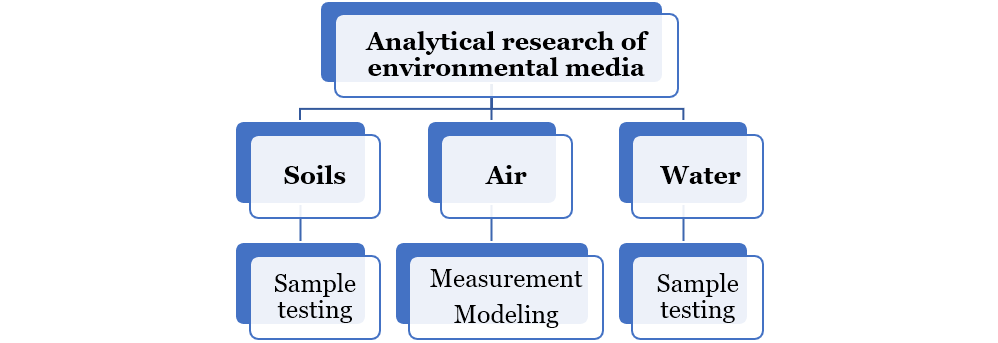
The methods presented in Fig. 1 were used in the course of this research.
An analysis of the results demonstrated the following:
The reviewed soil studies reported exceedances of maximum permissible concentrations (MPCs) for selected heavy metals and carcinogenic compounds in areas affected by guided aerial bomb and missile strikes.
The analyzed studies indicated that heavy-metal contamination may persist over time. Reported exceedances of maximum permissible levels in food samples were interpreted by the authors as supporting enhanced monitoring, remediation of contaminated areas, and measures to ensure compliance with applicable food-safety standards.
Studies have been conducted to assess the hazards of waste generated by military operations (shelling) to ensure safe, from an epidemiological standpoint, management of waste resulting from the Russian Federation’s armed aggression in the Kyiv region. Based on a cross-sectoral partnership within the “Health in All Policies” policy direction of the Central Committee for Public Health, Hydromet, the departments of ecology, education, urban planning, and architecture of city councils, and local communities have established and organized a system to monitor the concentration of these pollutants in the ambient air, and relevant information has been prepared for submission to local executive authorities.
The composition of emissions from industrial enterprises was studied, and a list of pollutants that may be additionally formed in the surface layer of the atmosphere during military operations was substantiated.
Studies conducted to model pollution in the surface layer of the atmosphere using 1-hour concentrations of pollutants have shown a correlation between these concentrations and the timing of missile and air raid threats. An electronic database has been created to monitor air quality in Kyiv (for hourly concentrations of PM2.5, PM10, CO, NO2, and SO2). Corresponding assessments of health risks to the population during emergencies have been conducted.
Given the stagnation of industry due to infrastructure destruction, the “Environmental Protection Program for the Phased Reduction of Pollutant Emissions by Economic Entities in Zaporizhzhia” was developed, based on public health risk assessments.
Proposals were submitted for the “State Monitoring Program for Air Quality Protection in the ‘Ternopil’ Zone for 2022–2025.” For the first time, a methodology has been developed for calculating the extent of damage caused to the atmosphere by uncontrolled emissions of pollutants or mixtures of such substances resulting from military operations, emergencies, or hazardous incidents at industrial or other facilities, based on a probabilistic approach.
Within the framework of European integration, it has been demonstrated that the size (width) of a sanitary protection zone depends on the nature and capacity of production, the characteristics of technological processes, the physical and geographical conditions of the location, and the impact of adverse factors and risks to human health, on the basis of which a new version of State Sanitary Norm 173 “Planning and Development of Settlements” has been developed, which complies with the Laws of Ukraine “On the Public Health System” and “On Ensuring the Sanitary and Epidemic Well-being of the Population.”
The reviewed radiation-safety work evaluated potential additional radon exposure associated with time spent in bomb shelters. The manuscript reports a maximum radon concentration value of 137 Bq/m3. Under a conservative scenario of 7,200 hours of air-raid alerts, such conditions contribute to a potential additional radiation burden on the general population, with children being particularly vulnerable to this prolonged exposure.
In the context of harmonization with international drinking-water guidance, the reviewed work substantiated consideration of changing the chlorite limit from 0.2 mg/dm3 to 0.7 mg/dm3 and proposed further optimization of chlorine-dioxide-based water treatment.
Proposals have been developed for amendments to the current DSanPiN (State Sanitary Norms and Rules) 2.2.4-171-10 “Hygienic Requirements for Drinking Water Intended for Human Consumption” (Order of the MoH of Ukraine No. 341 dated February 18, 2022). Proposals were prepared and taken into account regarding the change of national standards for chlorites and chlorates in drinking water to a limit of 0.7 mg/dm3. These were included in the State Sanitary Norms and Rules “Safety Indicators and Selected Quality Indicators for Drinking Water under Martial Law and Other Emergency Situations.” Proposals were prepared for an order of the Ministry of Health of Ukraine: On the Approval of Amendments to the State Sanitary Norms and Rules “Hygienic Requirements for Drinking Water Intended for Human Consumption.”
In the field of biosafety and biosecurity, the projects addressed antimicrobial resistance and evaluated the activity, safety, quality, and practical use of disinfectants. The work also incorporated the One Health approach and multidisciplinary collaboration involving epidemiology, veterinary medicine, and hygiene, while supporting laboratory-capacity development.
Research on children’s health examined associations between educational conditions, physical activity, anxiety, depressive symptoms, daily routines, and war-related factors. The analyzed studies reported a higher likelihood of post-traumatic stress symptoms among children exposed to adverse war-related conditions and evaluated the RCADS-P-25 scale for screening anxiety and depressive disorders in Ukrainian children and adolescents aged 8–18 years. The projects also assessed psychological tools intended to support prevention of anxiety and depressive symptoms in school settings.
In collaboration with the Department of Nutrition at the University of Helsinki, research examined eating behavior among school-age children exposed to war-related stress. The reported findings distinguished short-term stress-related changes from more persistent eating disturbances and informed methodological guidance concerning education, leisure, and child health under emergency conditions.
Medical and sanitary requirements for draft amendments to regulatory documents in urban planning legislation have been substantiated and developed: “Preschool Educational Institutions,” “Educational Institutions,” “Health Care Facilities,” “Civil Defense Structures,” and “State Sanitary Rules for the Planning and Development of Settlements. State Sanitary Rules No. 173-96.”
Health and safety requirements have been developed in the form of the “Guidelines for the Design of Food Service Facilities in Preschools, General Secondary Schools, and Children’s Health and Recreation Centers in Accordance with Food Service Organization Models,” which have been implemented and approved in Code of Practice 4:2024.
In the field of health culture, an assessment of the impact of social segregation during the pandemic on the population’s physical activity and well-being was conducted in collaboration with the University of Surrey (United Kingdom); self-assessment programs were developed to promote the primacy of health and foster awareness of self-management of physical and mental health.
Recently, the Institute has participated in the preparation of 14 documents for the Verkhovna Rada, the Cabinet of Ministers, the National Security and Defense Council, the Security Service of Ukraine, the Ministry of Defense, the Ministry of Health, the National Academy of Medical Sciences of Ukraine, regional and city state administrations, and other ministries and agencies.
The institutional analysis identified 23 research projects conducted during 2022–2025 across environmental health, radiation protection, biosafety, laboratory capacity, children’s health, urban planning, and health culture, reflecting a broad public health response to emergency conditions.
The reviewed projects generated applied outputs including monitoring approaches, methodological guidance, regulatory proposals, laboratory-capacity initiatives, and health-risk assessments intended to support preparedness and response.
The findings highlight the importance of continued surveillance and risk assessment for war-related environmental contamination, drinking-water safety, radiation exposure, antimicrobial resistance, and the physical and mental health of children and other population groups.
Further implementation of the International Health Regulations in Ukraine may benefit from sustained multisectoral collaboration and integration of the One Health and Health in All Policies approaches into emergency preparedness, recovery, and public health decision-making.
Pereira P, Bašić F, Bogunovic I, Barcelo D. Russian-Ukrainian war impacts on the environment. Science of The Total Environment, 837, Article 155865. 2022.
Hook K, Marcantonio R. Environmental dimensions of conflict and clean-up in Ukraine. Environmental Science & Policy, 136, 118–125. 2022.
Levy BS, Sidel VW. Documenting the effects of armed conflict on health. The Lancet, 387(10031), 1884–1886. 2016.
Lazzari S, Rodier G. International Health Regulations: For pandemic influenza preparedness and response. The Lancet, 363(9426), 2011–2012. 2004.
World Health Organization. International Health Regulations (2005) (3rd ed.). World Health Organization. http://who.int. 2016.
Siedner MJ, Gostin LO, Cranmer HH, Kraemer JD. Strengthening the International Health Regulations: Lessons from the Ebola outbreak. Health Affairs, 34(5), 780–786. 2015.
Baker MG, Fidler DP. Global public health surveillance under new International Health Regulations. Emerging Infectious Diseases, 12(7), 1058–1065. 2006.
Kieny MP, Evans TG. Health system resilience: Solid preparation for the next pandemic. Bulletin of the World Health Organization, 94(11), 785. 2016.
Schumacher J, Conlon KC. Public health preparedness and response under the International Health Regulations: Challenges in conflict zones. The Lancet Global Health, 11(4), e502–e504. 2023.
Wernli D, Haustein T, Conne D, Ethier JL, Koch L, Richard F. Lessons learnt from implementation of the International Health Regulations (2005): A systematic review. Bulletin of the World Health Organization, 95(11), 771–778. 2017.
Law of Ukraine No. 4004-XII. On Ensuring the Sanitary and Epidemic Welfare of the Population. Bulletin of the Verkhovna Rada of Ukraine, (27), Art. 218. http://rada.gov.ua. 1994.
Haggerty TM, Hryhorczuk D. Public health in a time of war: The case of Ukraine. Journal of Public Health Policy, 44(2), 195–204. 2023.
Ministry of Environmental Protection and Natural Resources of Ukraine. Environmental damage caused by Russia's war against Ukraine: Combined data and assessments. Government Portal of Ukraine. 2024.
Ministry of Environmental Protection and Natural Resources of Ukraine. Reports on environmental damage resulting from military aggression (EcoZagroza Platform). 2024.
Ali S, Hussain S, Atif M, Zhang J. Impacts of the Russia-Ukraine war on global food security: A double-whammy of supply chain disruptions and rising prices. Foods, 11(15), Article 2305. 2022.
Angurets O, Khazan P, Kolesnikova K, Havránek M. Environmental consequences of Russian war in Ukraine 2022. Arnika / Clean Air for Ukraine. 2023.
Bousquet J et al. The impact of environmental pollution on health: A European perspective in the context of the war in Ukraine. European Journal of Public Health, 32(4), 511–513. 2022.
Rawtani D, Gupta G, Khatri N, Rao PK, Hussain CM. Environmental damages due to war in Ukraine: A perspective. Science of The Total Environment, 847, Article 157584. 2022.
Zibtsev S et al. Impact of the Russian invasion on Ukraine’s environment. Environmental Science & Policy, 137, 200–212. 2022.
UNICEF WASHClusterUkraine. Damage to water and sanitation infrastructure in Ukraine. 2023.
Vystavna Y, He G, Kumar P. Impact of the Russia–Ukraine armed conflict on water resources and water infrastructure. Nature Sustainability, 6, 512–521. 2023.
Vystavna Y et al. Warfare in Ukraine: Urgent need for water security and environmental protection. Science of The Total Environment, 832, Article 155106. 2022.
Dushkova D, Ignatieva M. Conflict-related environmental damages on health: The case of Ukraine. Frontiers in Public Health, 10, Article 1018318. 2022.
Hooker J, Lawler J. The environmental consequences of the war in Ukraine. Nature Reviews Earth & Environment, 3, 421–423. 2022.
Hryhorczuk D, Zibtsev S, McCarty M, Kocharovska O. The environmental health impacts of Russia's war on Ukraine. Journal of Occupational Medicine and Toxicology, 19(1), Article 1. 2024.
Hrynzovskyi AM et al. Hygienic assessment of the impact of hostilities on the state of the environment and public health. Journal of Education, Health and Sport, 13(2), 241–255. 2023.
Hryzodub OV. The impact of chronic stress under martial law on the health status of the Ukrainian population. Medical Perspectives, 28(2), 45–52. 2023.
Linnik K, Steptoe A. Mental health and wellbeing in the context of the war in Ukraine. The Lancet Psychiatry, 10(5), 312–314. 2023.
Jaremka LM et al. Psychoneuroimmunology: Psychological influences on immune function. Health Psychology, 32(5), 533–540. 2013.
Morey JN, Boggero IA, Scott AB, Segerstrom SC. Current directions in stress and human immune function. Current Opinion in Psychology, 5, 13–17. 2015.
Shields GS, Slavich GM. Lifetime stress exposure and health: A review of contemporary assessment methods and biological mechanisms. Social and Personality Psychology Compass, 11(8), e12335. 2017.
Steptoe A, Kivimäki M, Firth J. Chronic stress and environmental toxicity: Synergistic effects on immune function and public health. Annual Review of Public Health, 45, 123–141. 2024.
WWF-Ukraine. The impact of war on Ukraine's environment (Analytical reports on soil and water pollution). WWF. 2024.
Buzynnyi M, Mykhailova L. Long term studying of uranium and radium-226 activity in drinking water in some regions of Ukraine and assessment of corresponding hypothetical irradiation doses. Scientific Reports, 14(1), Article 2530. 2024.
Chorna V, Antomonov M, Kolomiets V, Syrota H, Syrota M, Pavlenko N. Psychological consequences of war as a real threat to young people with post-traumatic stress disorder. European Journal of Clinical and Experimental Medicine, 23(1), 135–140. 2025.
Pavlenko TO, Fryziuk MA, Tarasiuk OYe. On the issue of radon impact at workplaces in the existing exposure situation. Problems of Radiation Medicine and Radiobiology, 29, 152–162. 2024. doi:10.33145/2304-8336-2024-29-152-162doi.org/10.33145/2304-8336-2024-29-152-162doi.org/10.33145/2304-8336-2024-29-152-162
Gulich M, Fedorova D, Petrenko O, Vepsäläinen H, Erkkola M. War exposure and changes in eating behaviours in Ukrainian school-aged children: A cross-sectional online survey. Maternal & Child Nutrition, 21(1), e13729. 2024.
European Commission Joint Research Centre, Belis C, et al. Status of environment and climate in Ukraine. Publications Office of the European Union. Joint Research Centre Reports. europa.eu. 2025. doi:10.2760/629217710.2760/6292177 (online)10.2760/6292177 (online)
Turos OI, Koblianska AV, Petrosian AA. Actual issues of medical and environmental aspects of climate change. Zaporozhye Medical Journal, 27(4), 312–319. 2025.
Turos OI, Petrosian AA, Maremukha TP, Morhulova VV, Grabovets DM, Brezitska NV, Tsarenok TV. Long-term trends (compared to the pre-war period) and public health impact of surface ozone in Ukraine. Wiadomości Lekarskie, 77(4), 703–709. 2024.
Turos OI, Petrosian AA, Maremukha TP, Morhulova VV, Brezitska NV, Kobzarenko IV, Tsarenok TV. Assessment of ambient air pollution by particulate matter (PM10, PM2.5) and risk for human health caused by war actions. Wiadomości Lekarskie, 76(4), 738–744. 2023.