

DOI: 10.5281/zenodo.22060444 · UDC: [616.36-002-022.7:578.891]:316.644(478)
Obiective. Hepatitele virale B și C reprezintă o problemă importantă de sănătate publică. Studiul a evaluat nivelul de cunoștințe, atitudinile și practicile adulților incluși în studiu în Republica Moldova privind etiologia, căile de transmitere, prevenirea, vaccinarea și testarea pentru hepatitele virale B și C.
Metode. A fost efectuat un studiu transversal în perioada 2024–2025, pe un eșantion de 811 respondenți din regiunile Nord, Centru, Sud și Unitatea Teritorială Autonomă Găgăuzia. Rezultatele prezentate constituie o analiză interimară, colectarea datelor fiind în desfășurare. Datele au fost colectate printr-un chestionar structurat administrat cu ajutorul programului Epi Info. Au fost analizate caracteristicile sociodemografice, cunoștințele privind transmiterea și manifestările clinice, statutul vaccinal autoraportat și istoricul testării.
Rezultate. Eșantionul a inclus 651 de femei (80,3%), iar vârsta medie a fost de 41,1 ± 14,0 ani. Lucrătorii medicali au reprezentat 59,8% dintre respondenți. Etiologia virală a fost identificată corect de 86,4% dintre respondenți pentru hepatita B și de 86,6% pentru hepatita C. Vaccinarea autoraportată împotriva hepatitei B a fost menționată de 90,2% dintre asistente, 88,5% dintre medici și 41,6% din populația generală. Totodată, 44,3% au considerat eronat că hepatita C poate fi prevenită prin vaccinare, 24,2% au menționat sărutul ca modalitate de transmitere a hepatitei B, iar 22,1% au apreciat severitatea hepatitei B ca fiind comparabilă cu gripa.
Concluzii. Au fost identificate lacune de cunoștințe și diferențe privind vaccinarea și testarea între lucrătorii medicali și respondenții din populația generală. Sunt necesare activități informaționale adaptate grupurilor țintă și extinderea testării de rutină. Rezultatele trebuie interpretate ținând cont de structura eșantionului și de ponderea mare a lucrătorilor medicali.
Objectives. Viral hepatitis B and C remain important public health problems. This study assessed knowledge, attitudes, and practices among the adults included in the study in the Republic of Moldova regarding etiology, transmission routes, prevention, vaccination, and testing for viral hepatitis B and C.
Methods. A cross-sectional study was conducted in 2024–2025 among 811 respondents from the North, Centre, South, and Autonomous Territorial Unit of Gagauzia. The results presented are an interim analysis, as data collection is ongoing. Data were collected using a structured questionnaire administered with Epi Info. Sociodemographic characteristics, knowledge of transmission and clinical manifestations, self-reported vaccination status, and testing history were analyzed.
Results. The sample included 651 women (80.3%), and the mean age was 41.1 ± 14.0 years. Healthcare workers represented 59.8% of respondents. Viral etiology was correctly identified by 86.4% for hepatitis B and 86.6% for hepatitis C. Self-reported hepatitis B vaccination was reported by 90.2% of nurses, 88.5% of physicians, and 41.6% of the general population. However, 44.3% incorrectly believed that hepatitis C could be prevented by vaccination, 24.2% identified kissing as a route of hepatitis B transmission, and 22.1% considered hepatitis B severity comparable to influenza.
Conclusions. Knowledge gaps and differences in vaccination and testing were identified between healthcare workers and general-population respondents. Targeted information activities and expanded routine testing are needed. The findings should be interpreted in light of the sample composition and the high proportion of healthcare workers.
Viral hepatitis B and C remain leading causes of liver-related morbidity and mortality worldwide. According to the WHO 2026 Global Hepatitis Report, hepatitis B and C accounted for 1.34 million deaths in 2024 and for 287 million people living with chronic infection, of which 240 million with HBV [1, 2]. Despite the existence of an effective HBV vaccine and curative direct-acting antivirals for HCV, testing and treatment coverage rates have stalled below the WHO 2030 elimination targets [3].
In the Republic of Moldova, viral hepatitis B and C represent a public health priority addressed through successive national programmes for the control of viral hepatitis B, C and D, the programme currently in force covering the period 2024-2028 [4]. Universal newborn vaccination against HBV was included in the first National Immunisation Programme, approved by Government Decision No. 584 of 3 August 1994, and vaccination of newborns began in 1995 [5]. Acute HBV morbidity declined from 17.52‰₀₀₀ in 2000 to 0.16‰₀₀₀ in 2022, a result attributed mainly to vaccine coverage and improved injection safety [6]. The chronic burden has continued to rise, with HBV chronic prevalence reaching 1172.53‰₀₀₀ and HCV chronic prevalence 638.08‰₀₀₀ in 2022 [6].
Healthcare workers (HCWs) remain a high-risk occupational group. A seroprevalence study among HCWs in the Republic of Moldova demonstrated an AgHBs prevalence of 11.8% and a protective anti-HBs level (≥10 IU/mL) in only 58.6% of those tested, with the lowest values in older age groups. These findings may support consideration of booster strategies in selected occupational groups [7].
Knowledge, attitudes and practices (KAP) studies have been used internationally as a tool for the design of public health interventions, as awareness and behaviours strongly influence prevention, screening and treatment uptake [8]. A previously published systematic review identified inadequate knowledge of viral hepatitis B and C among both HCWs and the general population in multiple countries [9]. KAP data specific to the Republic of Moldova remain limited, and existing studies have addressed mainly healthcare personnel or particular regional subgroups [10, 11].
Such information is needed for the targeting of communication campaigns and for the planning of routine screening, especially given the contrast between the population coverage objectives in the national programme and the current gaps in vaccine uptake and testing in the general population.
The aim of the study was to assess the level of knowledge, attitudes and practices regarding viral hepatitis B and C among the adults included in the study in the Republic of Moldova, stratified by occupational group, age group and region.
Data collection for a cross-sectional study began in January 2024 and is ongoing; the present work is an interim analysis of the questionnaires completed up to 31 December 2025. Respondents were recruited by non-probability sampling at institutional level: field teams visited primary healthcare facilities, hospitals and educational institutions in the North, Centre, South and UTA Gagauzia regions of the Republic of Moldova, and all adults present at the site on the day of the visit were invited to participate. Healthcare workers were approached at their workplace and students at their educational institution; respondents from the general population were recruited in the waiting areas of primary healthcare facilities. No quota was imposed on sex, age or occupation, which explains the predominance of women and of healthcare workers in the final sample. The recruitment target for this stage was set a priori at a minimum of 784 respondents, the number required to estimate a proportion of 50% with a margin of error of ±3.5% at a 95% confidence level; the 811 complete questionnaires available at the cut-off date correspond to a margin of error of ±3.4%. A total of 836 questionnaires were distributed; 25 were returned blank and were excluded, leaving 811 complete questionnaires for analysis, which corresponds to a response rate of 97.0%. Recruitment continues, with priority given to the South and to UTA Gagauzia, and the present estimates will be updated once the full sample is accrued. Participation was voluntary and anonymous. The study was approved by the Research Ethics Committee of ”Nicolae Testemițanu” State University of Medicine and Pharmacy (approval No. 9 of 14 April 2023), and written informed consent was obtained from every participant by signature on the first page of the questionnaire before administration.
The questionnaire was developed at the Discipline of Epidemiology of ”Nicolae Testemițanu” State University of Medicine and Pharmacy and applied in paper format, using EpiInfo (CDC, USA) for data entry. It was not submitted to a formal expert-panel review. A pilot phase involving 100 respondents preceded the main data collection and followed approval by the Research Ethics Committee. The instrument included items on socio-demographic characteristics (sex, age, marital status, monthly income, place of residence, level of education, occupation, and professional profile among HCWs), perceived information level, sources of information, knowledge of the cause of infection, modes of transmission, sources of infection, biological fluids of concern, clinical signs and perceptions regarding the severity of HBV and HCV. Attitudinal items covered the perception of the diseases as preventable, treatable or comparable to common infections, and the willingness to be vaccinated or tested. The practice section included vaccination status, history of testing, and self-reported past diagnosis of HBV or HCV. For HCWs, additional items were included on standard precautions, glove use according to the route of injection, recapping of needles, response to needlestick injuries, knowledge of post-exposure measures, and lifetime needlestick exposure. The pilot indicated that the coverage of standard precautions among healthcare workers was incomplete, and a dedicated set of items on this topic was introduced during data collection rather than at its start. A subset of the practice items was added in the second phase of data collection and was answered by 320 respondents in total, of whom 223 were HCWs (223/485; 46.0%), 96 were students and 1 belonged to the general population; the analysis of these items was restricted to the 223 HCWs.
Data were entered in Epi Info 7 (CDC, Atlanta, USA) and analysed in Epi Info, Microsoft Excel and Python 3.12. Frequencies and proportions were computed for categorical variables and 95% confidence intervals (CI) for proportions were obtained by the Wilson method. Continuous variables (age) were summarised as mean ± standard deviation. Differences between occupational groups, age groups and regions were tested with the Pearson chi-squared test; a two-sided p<0.05 was considered statistically significant. Because occupational group, sex, age, education and region are mutually correlated in this sample, three multivariable binary logistic regression models were fitted, for self-reported HBV vaccination, for lifetime HBV testing and for the belief that HCV is preventable by vaccination, each adjusted simultaneously for sex, age (continuous), occupational group, level of education and region; adjusted odds ratios (aOR) with 95% CI are reported and discrimination was assessed by the area under the ROC curve (AUC). The internal consistency of the 30-item transmission-knowledge scale (15 HBV and 15 HCV items, incorrect routes reverse-scored) was assessed by the Kuder-Richardson 20 coefficient. Stratified analyses by occupational group (physicians, nurses, students and the general population), age group (18-29, 30-44, 45-59 and ≥60 years) and geographic region were performed. Denominators for items added later in the data collection process are reported separately for each indicator. For items permitting multiple responses, participants could select more than one option; consequently, the total percentages may exceed 100%.
Sample characteristics. The sample comprised 811 adult respondents, 80.3% women and 19.7% men, with a mean age of 41.1 ± 14.0 years (range 18-75). Healthcare workers represented 59.8% of the sample, students 12.9% and general-population respondents 27.3%. By region, 47.2% resided in the North (predominantly in Bălți), 48.6% in the Centre (predominantly in Chișinău), 2.8% in the South and 1.4% in UTA Gagauzia. Higher education was reported by 51.3% and college-level education by 33.3%; the remaining 15.7% had specialised secondary, vocational or general school education only, or no formal studies. Most respondents were married (67.6%). Sample characteristics are detailed in Table 1. Internal consistency of the transmission-knowledge scale, computed post hoc on the study data, was acceptable (KR-20 = 0.819).
| Characteristic | Category | n | % |
|---|---|---|---|
| Sex | Female | 651 | 80.3 |
| Male | 160 | 19.7 | |
| Age group (years) | 18-29 | 201 | 24.8 |
| 30-44 | 272 | 33.5 | |
| 45-59 | 244 | 30.1 | |
| 60 and over | 94 | 11.6 | |
| Occupation | Physicians | 165 | 20.3 |
| Nurses | 295 | 36.4 | |
| Auxiliary medical staff | 25 | 3.1 | |
| Students | 105 | 12.9 | |
| General population | 221 | 27.3 | |
| Region | North | 383 | 47.2 |
| Centre | 394 | 48.6 | |
| South | 23 | 2.8 | |
| UTA Gagauzia | 11 | 1.4 | |
| Education | Higher education | 416 | 51.3 |
| College | 270 | 33.3 | |
| Other or none | 127 | 15.7 |
Knowledge of the cause and information sources. The viral aetiology was correctly identified by 86.4% of respondents for HBV and by 86.6% for HCV. Misattributions to bacteria (8.0% HBV, 7.8% HCV), drugs (3.1% HBV, 4.2% HCV) and alcohol (2.5% HBV, 1.5% HCV) were noted. Awareness of the two infections was high: 98.9% had heard of HBV and 97.8% of HCV. Self-perceived information level was reported as good (53.1%), very good (22.6%), poor (22.6%) or absent (1.7%). The most frequently reported source of information was the family physician (76.1%), followed by television (37.6%), printed materials such as brochures and posters (37.5%), internet search engines (36.9%) and newspapers (33.5%); social networks ranked lower (Facebook 29.1%, Instagram 16.5%, TikTok 8.0%). Online sources were used most in the 18-29 age group (search engines 54.7%, Instagram 31.3%, TikTok 22.9% versus 23.4%, 7.4% and 0% respectively in respondents aged 60 years and over).
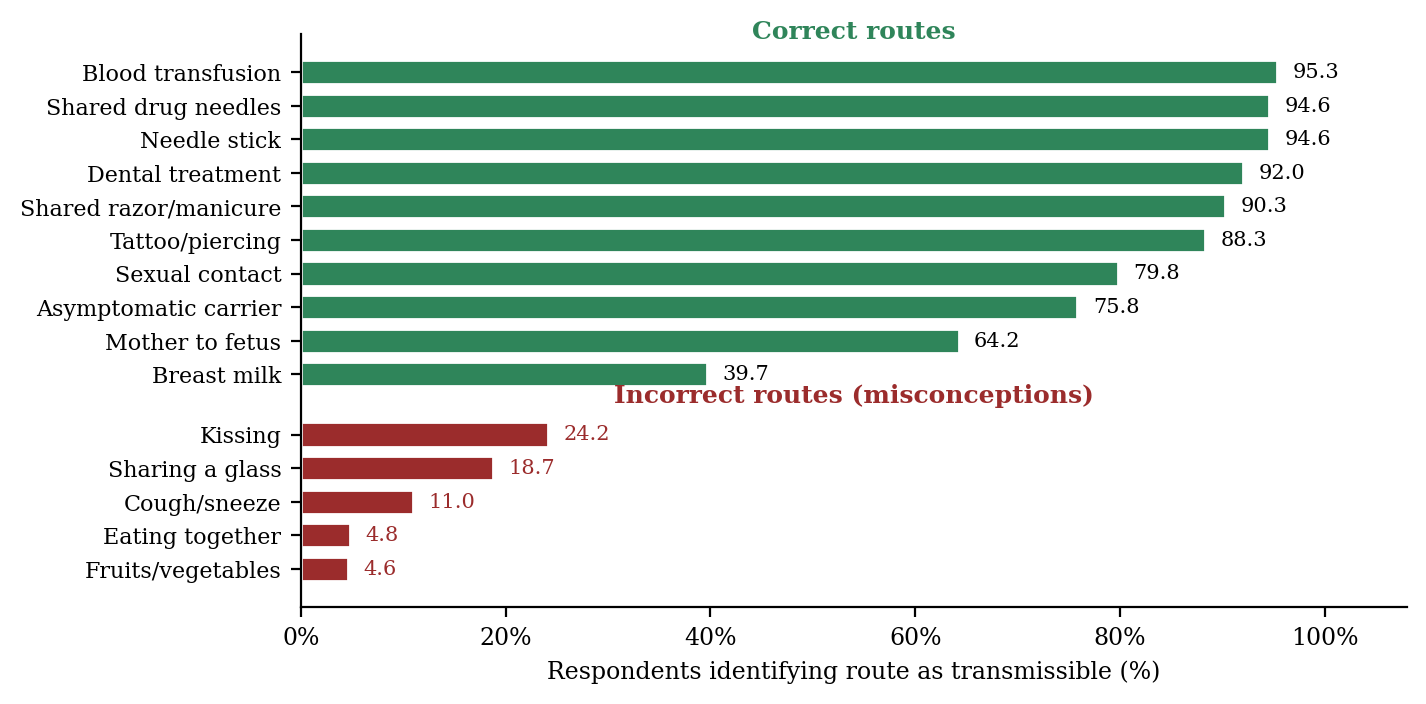
Modes of transmission. Routes involving direct blood contact were identified correctly by most respondents, including blood transfusion (95.3%), needle stick previously used on another patient (94.6%), sharing needles for drug use (94.6%), dental treatment (92.0%), shared razors and manicure tools (90.3%) and tattoo/piercing (88.3%). Lower levels of recognition were observed for sexual transmission (79.8%), the asymptomatic carrier (75.8%), vertical transmission from mother to fetus (64.2%) and transmission through breast milk (39.7%). Several misconceptions persisted: 24.2% considered kissing to be a route of transmission, 18.7% believed that sharing a glass with an infected person could transmit infection, and 11.0% identified coughing or sneezing as transmission routes (Figure 1).
Biological fluids and sources of infection. Blood was correctly identified as a risk fluid by 97.0% of respondents for HBV and 97.5% for HCV. Semen and vaginal secretions were identified by 62.4% (HBV) and 61.0% (HCV), while amniotic fluid was identified by 36.0% and 32.6% respectively. Saliva was incorrectly identified by 24.3% of respondents for HBV and 18.4% for HCV. The sick person was identified as a source of infection by 93.8% (HBV) and 95.6% (HCV), but the asymptomatic carrier by only 74.8% and 74.0%. Non-existing sources such as mosquitoes (10.1% HBV, 8.4% HCV) and lice (3.9% HBV, 3.3% HCV) were endorsed by small but consistent proportions of respondents, reflecting confusion with vector-borne diseases.
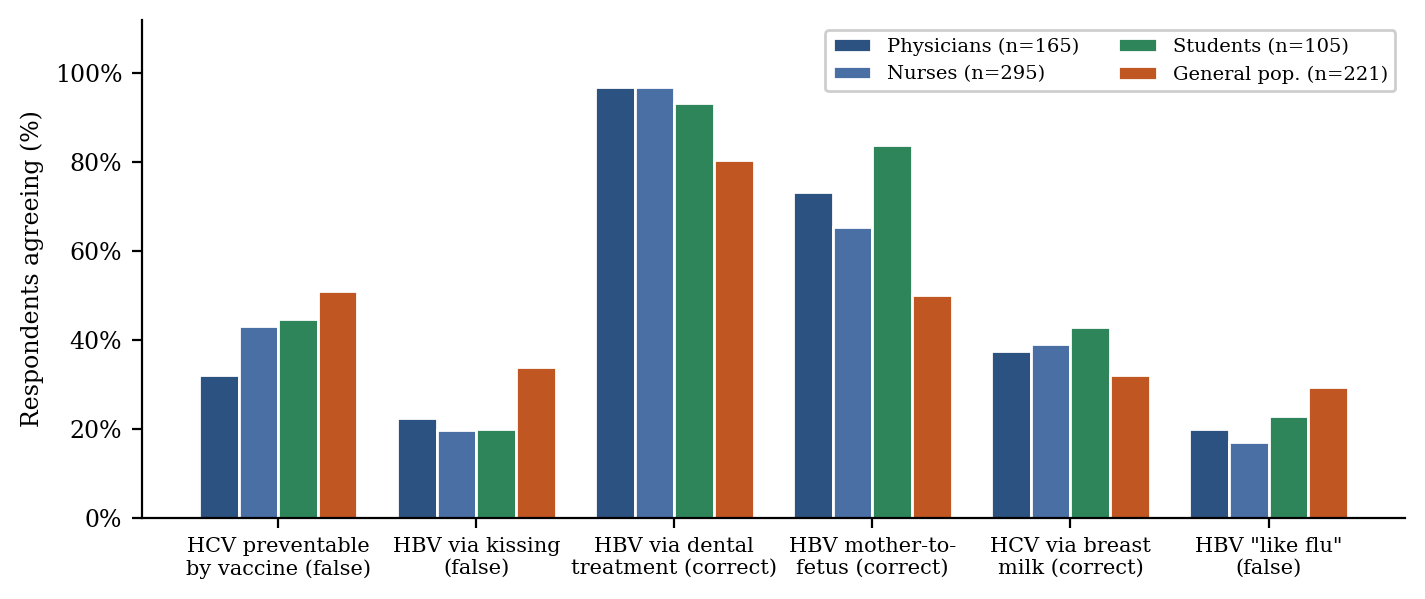
Severity and preventability. Progression of HBV to liver cirrhosis was acknowledged by 89.0% of respondents and to liver cancer by 79.0%; the corresponding values for HCV were 91.1% and 87.3% respectively. HBV was correctly identified as preventable by vaccination by 85.2% of respondents. A critical misconception was identified for HCV: 44.3% incorrectly stated that HCV is preventable by vaccination, although no HCV vaccine is currently available. The misconception varied significantly by occupational group, being highest in general-population respondents (51.1%) and lowest among physicians (32.1%) (χ2=14.02; df=3; p=0.003); in the multivariable model, only the physician category remained independently associated with a lower probability of endorsing it (aOR 0.37; 95% CI 0.23-0.61; p<0.001), whereas education and region were not (Table 3). A further misconception was the comparison of HBV with influenza, endorsed by 22.1% and indicating an underestimation of severity (Figure 2).
Vaccination status and reasons. Self-reported HBV vaccination reached 74.2% (95% CI 71.1-77.1) in the total sample, with marked differences by occupational group: 90.2% among nurses, 88.5% among physicians, 82.9% among students and 41.6% among general-population respondents (χ2=187.87; df=3; p<0.001) (Figure 3). Pooled, coverage was 87.2% among HCWs and 54.9% among non-HCWs (χ2=104.70; df=1; p<0.001). Among vaccinated respondents (n=602), the main motivations were occupational protection (73.9%) and personal precaution (33.2%). Among non-vaccinated respondents (n=127), the most frequent reasons were the perception that vaccination was not needed (29.9%) and lack of trust in vaccine safety (17.3%); religious objection, fear of infertility and concerns about autism were rare but persistent (4, 4 and 3 respondents in the full sample). Acceptance of vaccination among respondents who had not yet immunised was expressed by 62.2% of the non-vaccinated subgroup.
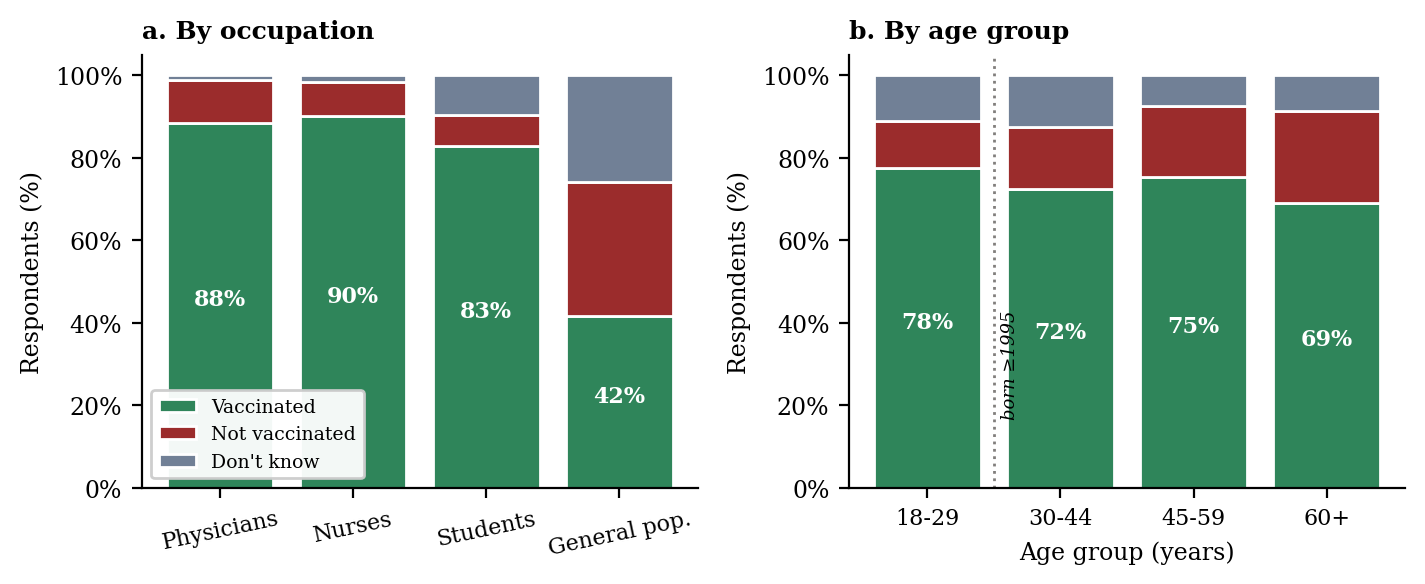
Age and region. In the 18-29 age group, born entirely after the introduction of universal newborn HBV vaccination in 1995, the self-reported vaccination rate was 77.6%, with 11.4% "no" and 10.9% "do not know" responses; coverage did not differ significantly across age groups (77.6%, 72.4%, 75.4% and 69.1% respectively; χ2=3.11; df=3; p=0.375). These findings suggest both the presence of an under-vaccinated subgroup and an information gap regarding personal vaccination history, relevant for the planning of accessible vaccination registries. Self-reported vaccination also differed by region: 90.9% in the North, 58.6% in the Centre, 69.6% in the South and 63.6% in UTA Gagauzia (χ2=106.42; df=3; p<0.001; the estimates for the South and UTA Gagauzia rest on 23 and 11 respondents respectively and are imprecise). The high coverage in the North is partly attributable to sample composition, HCWs representing 89.6% of the northern subsample against 33.0% of the central one; however, the difference persisted within both strata (HCWs 93.3% in the North versus 71.5% in the Centre; non-HCWs 70.0% versus 52.3%) and after adjustment for sex, age, occupation and education (aOR 3.37; 95% CI 2.02-5.63; p<0.001), so composition alone does not account for it.
Testing and practices. At least one lifetime HBV test was reported by 70.5% of respondents and one HCV test by 64.5%. Testing rates were higher among HCWs (92.1% HBV, 86.1% HCV among physicians; 89.8% and 84.7% among nurses) than among students (42.9%, 36.2%) and the general population (41.6%, 34.4%). Differences by occupational group were significant for both infections (χ2=217.17 for HBV and 210.23 for HCV; df=3; p<0.001), and occupation remained the dominant predictor after adjustment (physicians aOR 13.10, nurses aOR 13.96 versus the general population; Table 3). A self-reported history of HBV infection was declared by 55 respondents (6.8%) and of HCV by 25 (3.1%), with no significant difference between HCWs and non-HCWs (HBV 6.0% versus 8.0%, p=0.334; HCV 3.3% versus 2.8%, p=0.820). A lifetime needlestick injury was reported by 86 of the 223 HCWs who answered this item (38.6%; 95% CI 32.4-45.1), with a higher prevalence among nurses (60/128; 46.9%) than physicians (26/94; 27.7%) (χ2=7.64; df=1; p=0.006). Recapping of needles was reported by 34.5% of HCWs, a practice not consistent with current Infection Prevention and Control (IPC) recommendations [12]. The notification of superiors following occupational exposure was reported by only 25.6% (95% CI 21.9-29.6) of the 485 HCWs. Practice indicators are presented in Table 2.
| Practice indicator | n | % |
|---|---|---|
| Lifetime needlestick injury (n=223) | 86 | 38.6 |
| Recapping of used needles (n=223) | 77 | 34.5 |
| Gloves for intravenous injection (n=223) | 221 | 99.1 |
| Change of gloves between patients (n=223) | 216 | 96.9 |
| Knowledge of post-exposure measures (n=223) | 219 | 98.2 |
| SOP on standard precautions available (n=223) | 186 | 83.4 |
| Wash with soap and water after exposure (n=485) | 177 | 36.5 |
| Squeeze a drop of blood after exposure (n=485) | 136 | 28.0 |
| Inform superiors after exposure (n=485) | 124 | 25.6 |
| Variable (reference category) | aOR (95% CI) | p |
|---|---|---|
| Female sex (ref. male) | 1.86 (1.22-2.85) | 0.004 |
| Age, per year | 0.99 (0.98-1.01) | 0.251 |
| Physicians (ref. general population) | 7.12 (3.86-13.11) | <0.001 |
| Nurses (ref. general population) | 4.26 (2.05-8.85) | <0.001 |
| Students (ref. general population) | 5.26 (2.64-10.47) | <0.001 |
| Auxiliary medical staff (ref. general population) | 0.60 (0.23-1.55) | 0.293 |
| Higher education (ref. other or none) | 0.96 (0.50-1.85) | 0.908 |
| College education (ref. other or none) | 1.27 (0.58-2.75) | 0.549 |
| North region (ref. Centre) | 3.37 (2.02-5.63) | <0.001 |
| South and UTA Gagauzia (ref. Centre) | 1.21 (0.53-2.74) | 0.656 |
The 86.4-86.6% rate of correct identification of the viral aetiology exceeds the 71.2% recorded among preclinical medical students surveyed in Oman, of whom 84.8% had heard of hepatitis B [13], and is far above the 49% awareness reported among expectant mothers in a tertiary hospital in metropolitan India [14], but lower than the 96.1% among Chinese HBsAg-positive pregnant women [15]. The strong recognition of blood-borne transmission (94-95%) replicates the international pattern documented in the systematic review [9]. The lower recognition of vertical transmission (64.2%) is also consistent with gaps reported among preclinical medical students [13] and in the Brazilian general population [16].
The 44.3% who believed that HCV is preventable by vaccination is consistent with the limited knowledge of HCV prevention and transmission recorded in the Italian general population, 23.2% of which was also unaware that an HCV screening test exists [17], and closely matches the general population of Prishtina, Kosovo, in which only 53.6% correctly knew that no HCV vaccine is available [18]. The misconception is clinically important, as it may create a false sense of security and contribute to under-testing in at-risk groups. The HBV vaccination coverage among HCWs (88-90%) is comparable to the 88.1% among Iranian medical specialists [19]; comparable assessments among medical students have been reported from India [20]. Coverage was markedly higher than the 24.4% who had received at least one vaccine dose in South Kivu, DR Congo [21], and than the coverage reported in a Nigerian tertiary hospital [22]. The contrast with the 41.6% coverage in general-population respondents indicates that the national programme reaches newborns and HCWs effectively but lacks instruments for the catch-up of adult cohorts. The 25.6% rate of post-exposure notification is consistent with the under-reporting documented by Demsiss et al. [23] and Kabir et al. [19], and supports the reinforcement of post-exposure protocols in line with the national guide for the prevention and control of infections in hospital settings [12] and with Order of the Ministry of Health No. 749 of 11 September 2024 on the surveillance, prevention and control of healthcare-associated infections. The contrast between the medical and non-medical subsamples reproduces the pattern of knowledge gaps and low screening uptake described in general-population surveys in France [24], Thailand [25] and South Korea [26], despite established national programmes. The low rate of post-exposure notification is likewise consistent with the shortcomings in viral hepatitis notification documented among health professionals in Gauteng, South Africa [27], while the persistence of misconceptions in a healthy adult population has also been reported in Saudi Arabia [28].
The use of non-probability sampling and the over-representation of HCWs (59.8%), of women (80.3%) and of participants from the urban centres of Bălți and Chișinău limit the generalisability of the findings; the results describe the populations surveyed rather than the adult population of the Republic of Moldova, and the aggregate figures are shifted upwards for every indicator on which HCWs outperform the general population, in particular vaccination, testing and knowledge of transmission. For this reason the results are reported by occupational group throughout and the aggregate values should not be read as national estimates. Because women are also over-represented and female sex was independently associated with vaccination (aOR 1.86), the total coverage of 74.2% is likewise an overestimate for the general adult population. Self-reported vaccination and testing histories are subject to recall and social desirability biases. In particular, some students may not have been aware of vaccinations received during childhood, which could have contributed to inaccurate reporting of vaccination status and to gaps in knowledge regarding their personal vaccination history. The questionnaire was purpose-built and was not evaluated by an external expert panel; acceptable internal consistency does not establish content validity, and comparability with studies using formally validated instruments is therefore limited. The addition of the standard-precautions items during data collection means that the instrument was not identical for all respondents. In addition, a subset of practice items was introduced during the second phase of data collection and was answered by 223 of the 485 HCWs; the corresponding denominator is reported separately for every affected indicator, and the resulting subsample may not be representative of all HCWs surveyed. The multivariable models adjust for the measured covariates only, so residual confounding by unmeasured factors such as employer vaccination policy or duration of professional activity cannot be excluded. Finally, the results reported here are an interim analysis of an ongoing data collection and are therefore provisional; the estimates may change as recruitment progresses, in particular for the regions that are currently under-represented. The South and UTA Gagauzia regions are under-represented in the study sample.
Substantial knowledge gaps were identified among the adults included in the study in the Republic of Moldova regarding viral hepatitis B and C. The most concerning misconception was the belief that HCV is preventable by vaccination, endorsed by 44.3% of respondents and by 51.1% of the general non-medical subsample.
A marked gap was documented in the self-reported HBV vaccination coverage between healthcare workers (88-90%) and general-population respondents (41.6%). Among the 18-29 age cohort, eligible for routine HBV vaccination since the introduction of universal newborn immunisation in 1995, 10.9% did not know their vaccination status. Healthcare worker practices showed adequate glove use but low post-exposure notification (25.6%) and persistent needle recapping (34.5%), both inconsistent with current IPC recommendations, in a subsample in which 38.6% reported at least one lifetime needlestick injury.
Targeted communication campaigns on the absence of an HCV vaccine, the routes of transmission and the availability of curative HCV treatment are required, with particular focus on general-population respondents. The expansion of routine screening, the implementation of accessible vaccination records and the reinforcement of post-exposure protocols are recommended as priorities for the next phase of the National Programme for the Control of Viral Hepatitis.
World Health Organization. Efforts to eliminate hepatitis delivers gains but more action needed to meet 2030 targets. Accessed August 17, 2026. https://www.who.int/news/item/28-04-2026-efforts-to-eliminate-hepatitis-delivers-gains-but-more-action-needed-to-meet-2030-targets
World Health Organization. Global hepatitis report 2026. World Health Organization; 2026. Accessed August 17, 2026. https://www.who.int/publications/i/item/9789240122383
Pan American Health Organization. WHO sounds alarm on viral hepatitis infections claiming 3500 lives each day. Accessed August 17, 2026. https://www.paho.org/en/news/10-4-2024-who-sounds-alarm-viral-hepatitis-infections-claiming-3500-lives-each-day
Government of the Republic of Moldova. Hotărârea Guvernului nr. 863 din 18 decembrie 2024 cu privire la aprobarea Programului național de combatere a hepatitelor virale B, C și D pentru anii 2024–2028. Monitorul Oficial al Republicii Moldova. 2024;(564–568):art. 1013.
Government of the Republic of Moldova. Hotărârea nr. 584 din 3 august 1994 cu privire la aprobarea Programului Național de Imunizări pentru anii 1994–2000 [Government Decision No. 584 of 3 August 1994 approving the National Immunisation Programme for 1994–2000] [Internet]. Chișinău: Monitorul Oficial al Republicii Moldova; 1994 [cited 2026 Aug 19]. Romanian. Available from: https://www.legis.md/cautare/getResults?doc_id=118742&lang=ro.
Țîbîrnă A, Spînu C, Sajin O, et al. Provocări și perspective de eliminare a morbidității prin hepatita virală B și C în Republica Moldova. One Health Risk Manag. 2023;4(1S):46-47.
Sajin O, Spînu C, Spînu I, Paraschiv A. Hepatita virală B la lucrătorii medicali din Republica Moldova. Sănătate Publică, Economie și Management în Medicină. 2020;3(85):14-19.
World Health Organization. Advocacy, communication and social mobilization for TB control: a guide to developing knowledge, attitude and practice surveys. World Health Organization; 2008.
Călugăreanu V. Knowledge, attitudes, and practices of the population regarding viral hepatitis B and C worldwide: a systematic literature review. Mold J Health Sci. 2024;11(2):52-61. doi:10.52645/MJHS.2024.2.07
Spînu C, Sajin O, Isac M, et al. Hepatitele virale B, C și D în Republica Moldova: realizări și probleme. Sănătate Publică, Economie și Management în Medicină. 2019;4(82):352-363.
Sajin O, Spînu C, Suveica L, et al. Rezultatele implementării Programului Național de combatere a hepatitelor virale B, C și D în anii 2017–2018. Buletinul Academiei de Științe a Moldovei. Științe Medicale. 2018;3(60):28-34.
Ministry of Health of the Republic of Moldova. Ghid pentru prevenirea și controlul infecțiilor în instituția medico-sanitară spitalicească. Approved by Order No. 672 of August 9, 2024. Ministry of Health of the Republic of Moldova; 2024.
Sannathimmappa MB, Nambiar V, Arvindakshan R. Hepatitis B: knowledge and awareness among preclinical year medical students. Avicenna J Med. 2019;9(2):43-47.
Pawaskar R, Sadawarte D. Knowledge, attitude and practices regarding hepatitis B among expectant mothers seeking antenatal care in a tertiary care hospital in a metropolitan city. Indian J Public Health Res Dev. 2023;14(2):214-218.
Huang Z, Liu T, Qin Y, Chen J, Ou Z, Min X. A cross-sectional survey on the rate of awareness of hepatitis B virus (HBV) infection and the prevention of mother-to-child transmission among HBsAg-positive pregnant women. Ann Transl Med. 2022;10(14):773.
de Oliveira SB, Sabidó M, Pascom ARP, Gisiviez JM, Benzaken AS, Mesquita F. State of viral hepatitis knowledge and testing uptake in Brazil: findings from the National Survey of Knowledge, Attitudes and Practices (PCAP-2013). Hepatol Med Policy. 2016;1:3.
Lo Moro G, Scaioli G, Vola L, et al. Exploring knowledge and awareness of HCV infection and screening test: a cross-sectional survey among an Italian sample. J Community Health. 2023;48(5):769-783. doi:10.1007/s10900-023-01218-4
Rashiti-Bytyçi A, Rashiti P, Kadiri F, Svarça L, Xani A. Knowledge of hepatitis C among general population in Kosovo. Bangladesh J Med Sci. 2022;21(4):751-758.
Kabir A, Tabatabaei SV, Khaleghi S, et al. Knowledge, attitudes and practice of Iranian medical specialists regarding hepatitis B and C. Hepat Mon. 2010;10(3):176-182.
Vasantha Mallika MC, Sivaanusuya S. Knowledge attitude and practice on prevention of hepatitis B infection among medical students of a tertiary care centre in Tamil Nadu, India. Int J Res Med Sci. 2020;8(2):492-496.
Shindano TA, Bahizire E, Fiasse R, Horsmans Y. Knowledge, attitudes, and practices of health-care workers about viral hepatitis B and C in South Kivu. Am J Trop Med Hyg. 2017;96(2):400-404.
Adekanle O, Ndububa DA, Olowookere SA, Ijarotimi O, Ijadunola KT. Knowledge of hepatitis B virus infection, immunization with hepatitis B vaccine, risk perception, and challenges to control hepatitis among hospital workers in a Nigerian tertiary hospital. Hepat Res Treat. 2015;2015:439867.
Demsiss W, Seid A, Fiseha T. Hepatitis B and C: seroprevalence, knowledge, practice and associated factors among medicine and health science students in Northeast Ethiopia. PLoS One. 2018;13(5):e0196539.
Brouard C, Gautier A, Saboni L, Jestin C, Semaille C, Beltzer N. Hepatitis B knowledge, perceptions and practices in the French general population: the room for improvement. BMC Public Health. 2013;13:576. doi:10.1186/1471-2458-13-576
Phisalprapa P, Tanwandee T, Neo BL, Singh S. Knowledge, attitude, and behaviors toward liver health and viral hepatitis-related liver diseases in Thailand. Medicine (Baltimore). 2021;100(51):e28308.
Choi GH, Jang ES, Kim JW, Jeong SH. A survey of the knowledge of and testing rate for hepatitis C in the general population in South Korea. Gut Liver. 2020;14(6):808-816.
Mathatha ED, Manamela JM, Musekiwa A, Prabdial-Sing N. Exploring the knowledge, attitudes and practices (KAP) of health care professionals on viral hepatitis notification in Gauteng, South Africa, 2015. Arch Public Health. 2018;76:75.
Wedhaya M, Abyadh D, Alhabi H, et al. Assessment of knowledge, attitude and practice towards hepatitis B among healthy population in Saudi Arabia. Egypt J Hosp Med. 2017;69(2):1973-1977.