

DOI: 10.5281/zenodo.22087755 · UDC: 578.834.1:578.5(478)
Introduction. Continued genomic surveillance remains important after the end of the COVID-19 Public Health Emergency of International Concern, particularly in countries underrepresented in global sequencing datasets.
Material and methods. This descriptive longitudinal genomic surveillance study included 270 SARS-CoV-2 consensus genome sequences obtained from archived clinical specimens collected in the Republic of Moldova between 3 January 2023 and 20 August 2024. Specimens with sufficient viral RNA and a real-time RT-PCR cycle-threshold value of Ct <25 were selected. Sequencing was performed with the Illumina COVIDSeq workflow on the MiSeq Dx platform. Consensus generation and lineage assignment used DRAGEN COVID Lineage v4.0.7, Pangolin and Nextclade v3.16.0.
Results. Monthly sequencing volume varied from 1 to 81 specimens. BQ.1 predominated in January 2023 (23/40; 57.5%), followed by XBB-derived lineages. XBB.1.5 and XBB.1.9 each accounted for 14/28 sequences (50.0%) in April 2023. JN.1 represented 3/9 sequences (33.3%) in December 2023, 11/13 (84.6%) in January 2024 and all four sequences analyzed in April 2024. In July 2024, KP.3.1.1 accounted for 2/4 sequences (50.0%), while KP.3 and KP.3.3 each accounted for 1/4 (25.0%). The most frequently detected spike substitutions included G142D (201/270) and K417N (172/270).
Discussion. The sequence distribution showed successive replacement of BQ-, XBB- and JN.1-derived lineages. Substantial variation in monthly sample numbers and selection of specimens from hospitalized patients limit population-level interpretation of the reported frequencies.
Conclusions. The study describes SARS-CoV-2 lineage dynamics and recurrent spike substitutions among specimens sequenced in the Republic of Moldova. The findings support continued genomic surveillance using standardized sampling, transparent quality criteria and timely data sharing.
On 5 May 2023, the World Health Organization determined that COVID-19 no longer constituted a Public Health Emergency of International Concern; however, the spread of the disease has not stopped and SARS-CoV-2 continues to spread through the population, creating new lineages and sublineages [1]. With new mutations arising from different lineages of SARS-CoV-2, enhanced infectivity and the ability of immune escape can cause reinfection, particularly with the Omicron variants [2, 3]. Since the emergence of the Omicron variant in November 2021, a number of Omicron-derived lineages have continued to evolve and replace previous lineages. The sequencing of the SARS-CoV-2 genome is essential in the process of monitoring the evolution, spread and public health impact of the virus. As global attention shifts from acute pandemic response to long-term management of COVID-19, the continuous genomic surveillance remains crucial. Previous studies and national reports from the Republic of Moldova have emphasized the relevance of SARS-CoV-2 genetic diversity analysis, genomic monitoring, and evaluation of emerging Omicron-derived lineages for strengthening post-emergency public health surveillance [4-7].
The Republic of Moldova, a small country with lower sequencing throughput compared to larger nations provides a unique context for examining how global SARS-CoV-2 evolutionary trends are reflected at a smaller scale. This study aims to fill the knowledge gap regarding the post-emergency viral landscape in Moldova, providing insights into variant dynamics in a Southeastern European context. Also, it seeks to trace the genomic trajectory of SARS-CoV-2 in Moldova between January 2023 and August 2024, a period characterized by a transition from acute pandemic management to more endemic circulation. In our study we combined clinical metadata with the sequencing data to understand the genetic diversity of SARS-CoV-2 lineages circulating in the Republic of Moldova during the period following the end of the COVID-19 public health emergency (2023-2024), assessing their implications for public health strategies. By analyzing a comprehensive set of consensus viral genome sequences, we aimed to identify dominant lineages, characterize their temporal dynamics and assess their mutational profiles, particularly within the Spike protein, which is critical for viral infectivity and immune evasion. The work underscores the role of geographically distributed genomic surveillance and captures the local virological shifts contributing to a more complete understanding of SARS-CoV-2 evolution globally.
Sample collection. Archived nasopharyngeal/oropharyngeal swab specimens were obtained from hospitalized patients with COVID-19-compatible symptoms in public healthcare institutions between 3 January 2023 and 20 August 2024. A total of 270 SARS-CoV-2-positive specimens with sufficient viral RNA and a real-time RT-PCR cycle-threshold value of Ct <25 were selected for sequencing. Limited clinical and epidemiological metadata were recorded for surveillance purposes; these variables were not analyzed in the present study. The analytical dataset was anonymized.
Sample processing and sequencing. Total RNA was extracted from nasopharyngeal and oropharyngeal exudates stored at -70°C using the QIAamp Viral RNA Mini kit (Qiagen) [8], according to the manufacturer’s protocol. Genomic libraries were subsequently prepared using the Illumina COVIDSeq Assay kit [9], which enables high-throughput SARS-CoV-2 genome sequencing through a streamlined workflow comprising cDNA synthesis, targeted amplification, barcode indexing, and magnetic bead-based size selection. To enhance genome coverage, a modified and optimized version of the ARCTIC v4 primer set (COVIDSeq v4 Primer Pools) [10] was used in the amplification step.
Whole-genome sequencing of SARS-CoV-2 was performed for all samples using the Illumina MiSeq Dx platform with the MiSeq Reagent Kit v2 (300-cycle format), generating paired-end reads of 2 × 150 nucleotides. Real-time imaging and base calling were carried out on the Illumina instrument using the built-in base-calling pipeline. Demultiplexed sequencing data were exported in FASTQ format for downstream analysis.
Data analysis. Raw paired-end FASTQ files were processed with DRAGEN COVID Lineage v4.0.7 on the Illumina BaseSpace Sequence Hub. Reads were quality filtered and aligned to the SARS-CoV-2 reference genome NC_045512.2. Consensus sequences were generated after variant calling; genomic regions with insufficient coverage were masked with N bases. Coverage was evaluated at ≥10× and ≥30×, and specimens with insufficient genome coverage were excluded from the final analytical dataset. Pango lineage assignment was performed with Pangolin, and Nextclade v3.16.0 was used as part of the sequence-analysis workflow. The 270 sequences were analyzed in September 2024; the exact Pangolin database version could not be retrieved from the archived analysis record.
Temporal distribution of SARS-CoV-2 lineages. A total of 270 consensus genome sequences were analyzed. Monthly sequencing volume varied substantially, from one specimen in August 2023 to 81 specimens in February 2023 (Figure 1). No specimens were represented in June, July, September, October or November 2023, or in May and June 2024.
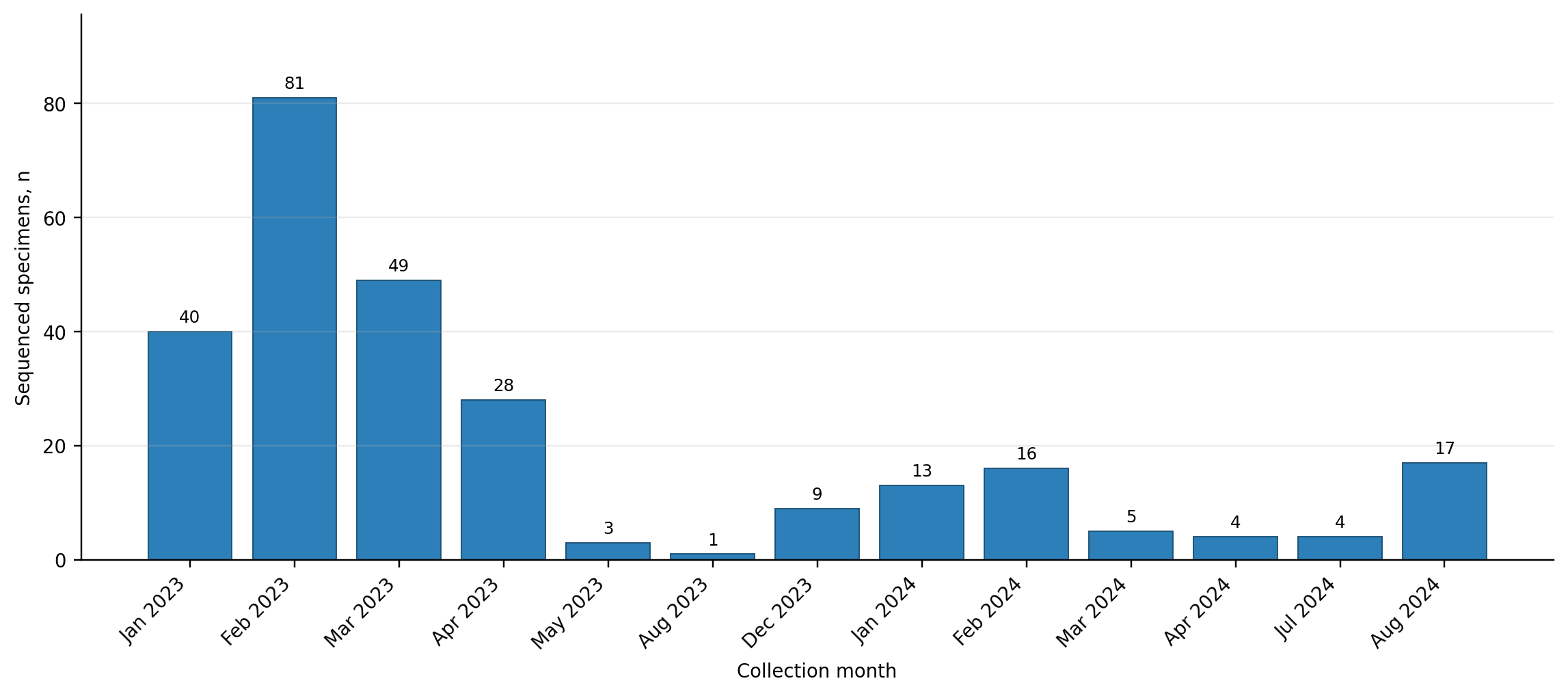
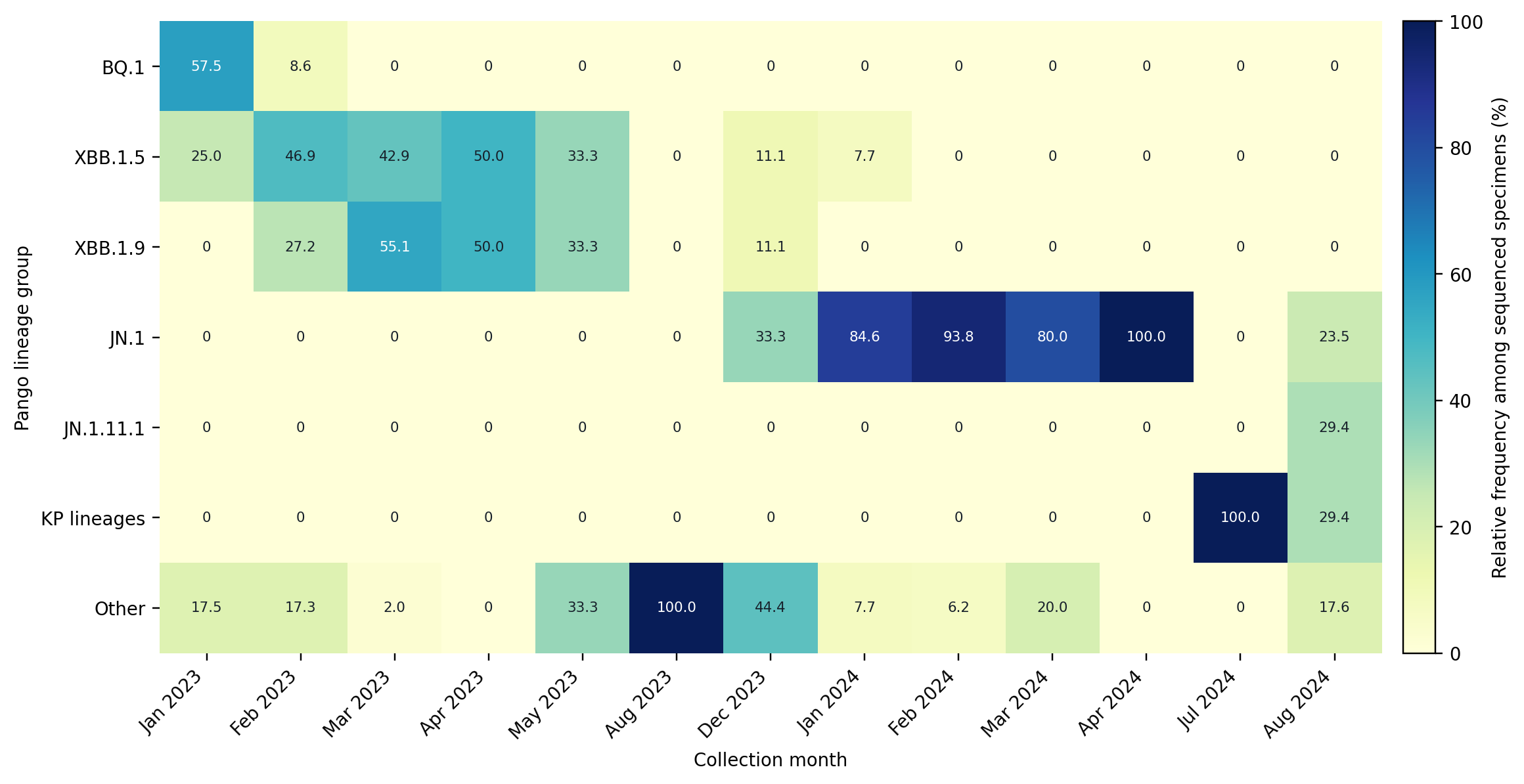
In January 2023, BQ.1 was the most frequently assigned lineage (23/40; 57.5%). XBB-derived lineages subsequently predominated: XBB.1.5 accounted for 38/81 sequences (46.9%) in February, while XBB.1.9 accounted for 27/49 (55.1%) in March. In April 2023, XBB.1.5 and XBB.1.9 each accounted for 14/28 sequences (50.0%). Only three specimens were analyzed in May 2023, one each assigned to XBB, XBB.1.5 and XBB.1.9; the single specimen analyzed in August 2023 was assigned to AY.46.6.
In December 2023, JN.1 accounted for 3/9 sequences (33.3%), increasing to 11/13 (84.6%) in January 2024, 15/16 (93.8%) in February, 4/5 (80.0%) in March and 4/4 (100%) in April. In July 2024, KP.3.1.1 accounted for 2/4 sequences (50.0%), while KP.3 and KP.3.3 each accounted for 1/4 (25.0%). In August 2024, JN.1.11.1 (5/17; 29.4%) and JN.1 (4/17; 23.5%) were the most frequent assignments; KP.2.3 and KP.3 each accounted for 2/17 (11.8%). Figure 2 summarizes the relative frequencies of major lineages; rare lineages are grouped as Other.
Mutational profile of the spike gene. Recurrent spike substitutions were identified in functionally relevant regions, including the N-terminal domain, receptor-binding domain and S2 region. The spike protein mediates viral entry through interaction with ACE2 and is a major target of neutralizing antibodies. Although previous studies have associated several detected substitutions with altered antigenicity, receptor interaction or protein stability, the present descriptive analysis did not directly test their functional effects. G142D was the most frequently detected substitution, occurring in 201 of 270 sequences (Figure 3).
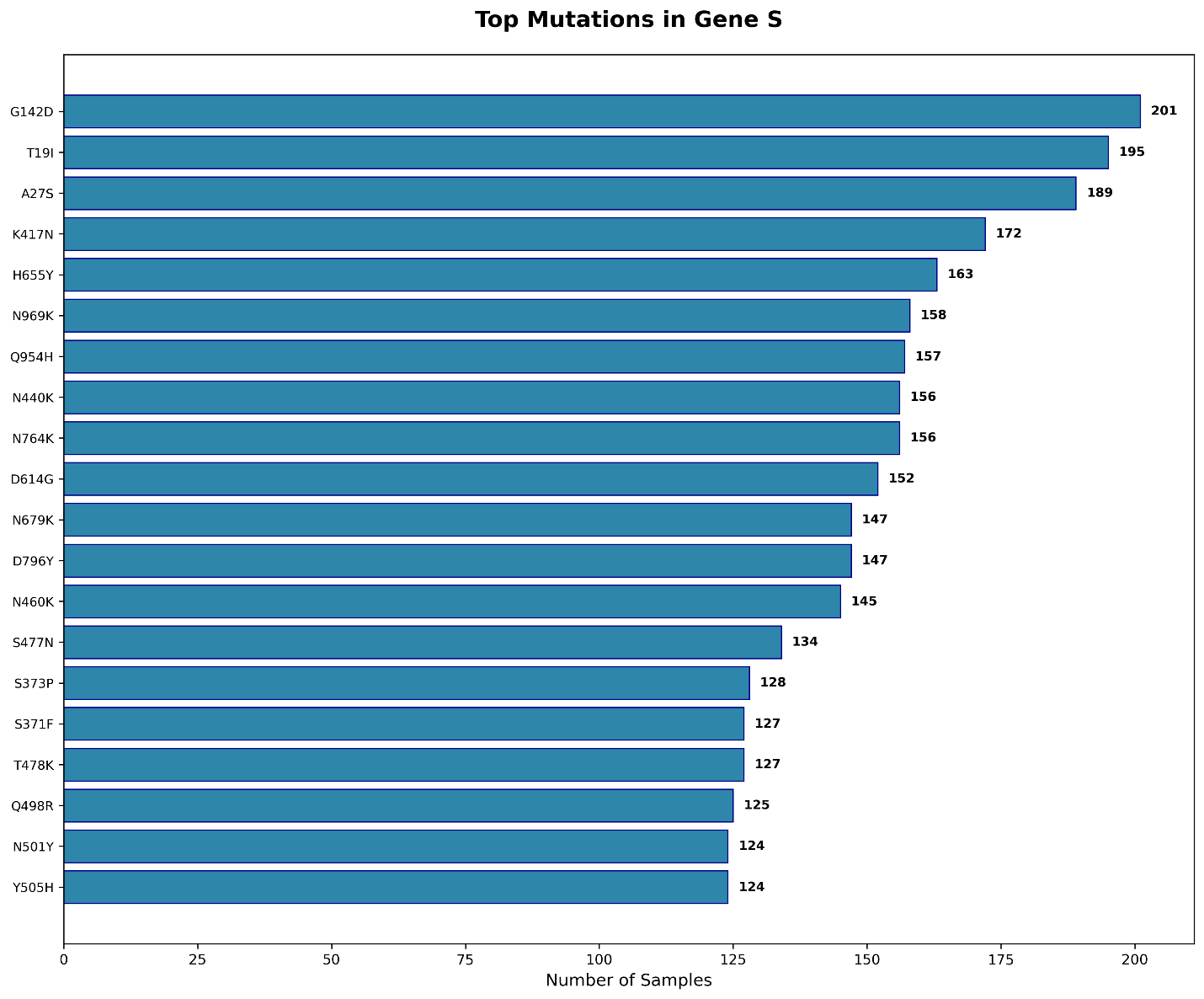
Located in the N-terminal domain (NTD) of the Spike protein the mutation has been associated in previous studies with immune escape mechanisms particularly through reduced recognition of epitopes (critical regions for host immune cells to recognize a specific pathogen) by neutralizing antibodies. G142D occurs in globally circulating strains such as Delta and Omicron [4, 16, 17] and is closely seconded in frequency by T19I and A27S also in the NTD which collectively emphasize this region as a mutation hotspot for enhanced viral evasiveness of humoral immunity. These three highest S gene mutations show that NTD is involved not just in antigenic drift, but also in continuous transmission within populations with prior immunity, natural or vaccine-immunity derived.
A further cluster of mutations is located in the S Receptor-Binding Domain (RBD), which has direct interaction with the human ACE2 receptor. They are specified in the order of their frequency as K417N, N440K, S477N, T478K, Q498R, N501Y, and Y505H. All have potential epidemiological relevance since they have a dual action in increasing receptor-binding affinity and reducing neutralization by antibodies. K417N, observed in 172 samples, is a signature mutation of Beta and Omicron strains and reduces antibody binding at a key RBD site. S477N and T478K, both found in Delta and Omicron lineages, enhance viral binding to ACE2 while also enabling immune evasion simultaneously. Similarly the next mutations (Q498R, N501Y and Y505H) form a previously well-documented genetic triad of newer Omicron strains that result in significantly enhanced ACE2 binding and immune evasion. Most notably all of them have independently evolved in different viral lineages, so-called convergent evolution where different strains accumulated functionally similar mutations [18].
A second set of mutations are located within the S2 region of the Spike gene, which plays a role in the membrane fusion and viral entry process. They are H655Y, N764K, Q954H, N969K and are frequently found in Omicron lineages. These mutations are not directly involved in receptor binding or immune recognition but play crucial roles in maintaining the trimer stability and conformational dynamics. of the Spike protein. Such roles are particularly crucial in highly mutated strains, where the plasticity of the Spike, even with high number of amino acid substitutions needs to be maintained to ensure viral infectivity. The other less frequent mutations also contribute to the optimization of Spike protein function. These mutations found in Omicron and its sublineages are related to protein plasticity, stability, and epitope exposure.
The genomic surveillance dataset showed a transition from BQ.1 and XBB-derived lineages in early 2023 to JN.1 and its descendants in 2024. The rise of JN.1 among the sequenced specimens was broadly consistent with its international expansion reported during the same period [14, 15]. However, monthly denominators varied substantially and several months were not represented; therefore, the reported frequencies describe the sequenced specimens and should not be interpreted as national prevalence estimates.
The detection of several KP lineages in July and August 2024 is consistent with diversification within the JN.1-derived lineage landscape. Because only four specimens were analyzed in July and 17 in August, these findings should be interpreted descriptively and cannot establish transmission advantage or population-level replacement.
Recurrent spike substitutions were concentrated in the N-terminal and receptor-binding regions. Several of these substitutions have previously been associated with altered antigenicity, antibody escape or ACE2 interaction [16-18]. The present study did not perform functional assays or formal selection analyses; consequently, biological effects cannot be inferred directly from mutation frequency alone.
These findings illustrate the value of sustained genomic surveillance in settings with lower sequencing throughput. Future surveillance would benefit from more uniform temporal and geographical sampling, complete preservation of bioinformatic version metadata and linkage of genomic findings with clearly defined epidemiological variables.
This descriptive genomic surveillance study characterizes SARS-CoV-2 lineage dynamics and recurrent spike substitutions among 270 specimens sequenced in the Republic of Moldova between January 2023 and August 2024. The sequence distribution showed successive predominance of BQ.1, XBB-derived lineages and JN.1, followed by diversification into JN.1-derived and KP lineages. Because sampling was restricted to selected specimens from hospitalized patients and monthly denominators varied substantially, the results should not be interpreted as national population prevalence or as direct evidence of functional effects. Continued genomic surveillance with standardized sampling, transparent quality criteria and timely data sharing remains important.
This study used selected archived specimens from hospitalized patients and may not represent SARS-CoV-2 circulation in the general population. Monthly sequencing volume varied substantially, several months were not represented and geographical coverage was not analyzed. The descriptive design does not establish that individual mutations caused enhanced transmissibility, immune escape or lineage expansion. The exact archived Pangolin database version could not be retrieved. Mutation frequencies were not supported by functional assays or formal selection analyses.
The study was conducted within the doctoral research project “Monitoring of COVID-19 infection through whole-genome sequencing and phylogenetic analysis of SARS-CoV-2 isolates” (research project No. 22 of 30 March 2023). The Research Ethics Committee of Nicolae Testemitanu State University of Medicine and Pharmacy reviewed the research protocol, participant information form, informed-consent form and confidentiality undertaking and issued favorable opinion No. 1 on 20 September 2023. The present analysis used anonymized archived SARS-CoV-2-positive specimens originally collected during routine clinical and public health surveillance; no directly identifying patient information was included in the analytical dataset.
According to the author, all 270 SARS-CoV-2 consensus genome sequences were deposited in the GISAID EpiCoV database. No sequences were deposited in GenBank. GISAID accession identifiers and anonymized clinical metadata may be obtained from the corresponding author, subject to GISAID attribution requirements and applicable institutional and ethical conditions.
The present study includes the 71 SARS-CoV-2 genomes previously reported in Colac et al. (Arta Medica. 2025;94(1):11–16) as part of the expanded dataset of 270 genomes. The current analysis extends the observation period and analytical scope by examining longitudinal lineage dynamics from January 2023 to August 2024 and by characterizing Spike gene mutation patterns across the expanded dataset. Results and analyses previously reported for the 71 genomes are not presented as novel findings; rather, these sequences are incorporated into the broader longitudinal analysis.
The author gratefully acknowledges Viorel Munteanu (Department of Computers, Informatics and Microelectronics, Technical University of Moldova, Chisinau, Moldova; Department of Biomedical Sciences, College of Medicine and Biological Sciences, University of Suceava, Suceava, Romania; ORCID: https://orcid.org/0000-0002-4133-5945) and Victor Sitnic (Moldova State University, Chisinau, Moldova; ORCID: https://orcid.org/0000-0002-0449-1527) for their valuable scientific and technical support, constructive discussions, and assistance during the preparation of this manuscript.
Burki T. WHO ends the COVID-19 public health emergency. Lancet Respir Med. 2023;11(7):588. doi:10.1016/S2213-2600(23)00217-5.
Pulliam JRC, van Schalkwyk C, Govender N, von Gottberg A, Cohen C, Groome MJ, et al. Increased risk of SARS-CoV-2 reinfection associated with emergence of Omicron in South Africa. Science. 2022;376(6593):eabn4947. doi:10.1126/science.abn4947.
Chung YS, Lam CY, Tan PH, Tsang HF, Wong SC. Comprehensive review of COVID-19: epidemiology, pathogenesis, advancement in diagnostic and detection techniques, and post-emergency treatment strategies. Int J Mol Sci. 2024;25(15):8155. doi:10.3390/ijms25158155.
Colac S, Ulinici M, Burduniuc O. Genetic diversity analysis of the SARS-CoV-2 virus: a literature review. One Health Risk Manag. 2025;6(1):16-28. doi:10.38045/ohrm.2025.1.02.
Colac S, Ulinici M, Burduniuc O. Analiza diversităţii genetice a virusului SARS-CoV-2: revista literaturii. In: Sănătatea și fenomenul rezistenței la antimicrobiene în țările cu venituri mici și medii din Europa de Est; January 24, 2024; Chișinău, Republic of Moldova. p. 136. Accessed June 17, 2026. Available at: https://ibn.idsi.md/ro/vizualizare_articol/19657.
Colac S, Sîtnic V, Burduniuc O. Genomic monitoring of SARS-CoV-2 variants in the Republic of Moldova. Arta Med. 2025;94(1):11-16. doi:10.5281/zenodo.15879875.
Colac S. Analiza secvențierii genomului SARS-CoV-2: evoluția și impactul noilor linii Omicron în Republica Moldova. In: Patrimoniul cultural de ieri – implicaţii în dezvoltarea societăţii durabile de mâine; February 11-12, 2025; Chișinău, Republic of Moldova. p. 280. Accessed June 17, 2026. Available at: https://ibn.idsi.md/ro/vizualizare_articol/244582.
QIAGEN. QIAamp Viral RNA Kits for RNA extraction. QIAGEN. Accessed June 17, 2026. Available at: https://www.qiagen.com/us/products/diagnostics-and-clinical-research/sample-processing/qiaamp-viral-rna-kits.
Illumina. Illumina COVIDSeq RUO Kits Reference Guide. Published December 5, 2024. Accessed June 17, 2026. Available at: https://support.illumina.com/downloads/illumina-covidseq-test-reference-guide-1000000126053.html.
Quick J. nCoV-2019 sequencing protocol v3 (LoCost). protocols.io. Published August 25, 2020. doi:10.17504/protocols.io.bp2l6n26rgqe/v3.
Focosi D, Spezia PG, Capria AL, Gueli F, McConnell S, Novazzi F, et al. Rise of the BQ.1.1.37 SARS-CoV-2 sublineage, Italy. Diagnostics (Basel). 2023;13(5):1000. doi:10.3390/diagnostics13051000.
Uraki R, Ito M, Furusawa Y, Yamayoshi S, Iwatsuki-Horimoto K, Adachi E, et al. Humoral immune evasion of the Omicron subvariants BQ.1.1 and XBB. Lancet Infect Dis. 2023;23(1):30-32. doi:10.1016/S1473-3099(22)00816-7.
Joi P. Here’s what we know about the new Omicron variant XBB.1.5. VaccinesWork. Published January 6, 2023. Accessed June 17, 2026. Available at: https://www.gavi.org/vaccineswork/heres-what-we-know-about-new-omicron-variant-xbb15.
Siddiqui AN, Musharaf I, Gulumbe BH. The JN.1 variant of COVID-19: immune evasion, transmissibility, and implications for global health. Ther Adv Infect Dis. 2025;12:20499361251314763. doi:10.1177/20499361251314763.
Wannigama DL, Amarasiri M, Phattharapornjaroen P, Hurst C, Modchang C, Chadsuthi S, et al. Wastewater-based epidemiological surveillance of SARS-CoV-2 new variants BA.2.86 and offspring JN.1 in South and Southeast Asia. J Travel Med. 2024;31(4):taae040. doi:10.1093/jtm/taae040.
Chavda VP, Bezbaruah R, Deka K, Nongrang L, Kalita T. The Delta and Omicron variants of SARS-CoV-2: what we know so far. Vaccines (Basel). 2022;10(11):1926. doi:10.3390/vaccines10111926.
Chaudhari AM, Joshi M, Kumar D, Patel A, Lokhande KB, Krishnan A, et al. Evaluation of immune evasion in SARS-CoV-2 Delta and Omicron variants. Comput Struct Biotechnol J. 2022;20:4501-4516. doi:10.1016/j.csbj.2022.08.010.
Focosi D, Quiroga R, McConnell S, Johnson MC, Casadevall A. Convergent evolution in SARS-CoV-2 Spike creates a variant soup from which new COVID-19 waves emerge. Int J Mol Sci. 2023;24(3):2264. doi:10.3390/ijms24032264.
Colac S, Burlac V, Sîtnic V. Determinanți genetici și ai virulenței în genomul microorganismelor cu impact major asupra sănătății publice. In: Abordarea O singură sănătate pentru securitatea sănătăţii globale; November 20-21, 2025; Chișinău, Republic of Moldova. p. 15. Accessed June 17, 2026. Available at: https://ibn.idsi.md/ro/vizualizare_articol/242245.
Colac S, Tapu L, Anton M, Perde D, Leekitcharoenphon P, Otani S, et al. Genomic surveillance of carbapenem-resistant Klebsiella pneumoniae in the Republic of Moldova. Front Microbiol. 2026;17:1791267. doi:10.3389/fmicb.2026.1791267.